

Learn to appreciate that SEO is like a giant poker game
Picture a virtual table with thousands of people playing at the same time in scores of places.
In this game, instead of collecting winnings from your fellow players, you’re seeking Google rewards. With each of your “keyword” hands, Google snickers at what you’re holding or rewards you with the top positions among the search engine results pages (SERPs).
When you target another keyword phrase, you’re dealt a new set of cards. Unlike real poker, this hand is not random. You end up with cards based on what you bring to the table.
What are your SEO strengths that will give you a good hand?
Rather than list all of the ranking factors, I’ll cite a few that should shape your keyword choices.
Domain and page authority
Based principally on backlinks, your score will influence your rankings. Moz tracks the data, and websites fall somewhere between 1 and 100. Do you even know how your site scores? Higher scores increase the odds of higher rankings.
Content and website size
Websites with some pages (like maybe 10 or 20) won’t fare as well as websites with hundreds or thousands of pages, which signal to search engines that they’re serious players. More pages make it easier for websites to play up key themes, attract backlinks, and add additional pages to target coveted keyword phrases.
Domain name
Online marketers debate its value toward your rankings. My sense is that its importance has waned, but it’s clearly a factor. If your domain includes part of your keyword phrase, you have an edge.
Other SEO essentials
You can’t afford to have issues with basic website structure. Is all of your content indexed? What about the following:
Content headers: Do you use H1 tags with the text?
SEO page titles: Can you customize them on a per-page basis?
Page URLs: Can you keep them short and use dashes to separate words?
To underscore the possibilities for 2019, I identified three companies through LinkedIn to see how well they’re already doing with SEO and to show ways we can learn from their efforts (good or bad).
Catalant – Identification of talent through technology and programs for companies
Taboola – Content discovery platform
Jellyvision – Creators of ALEX, employee communication software
Taboola is probably in the best shape with a domain authority of 72 (Jellyvision is 43 and Catalant is 36).
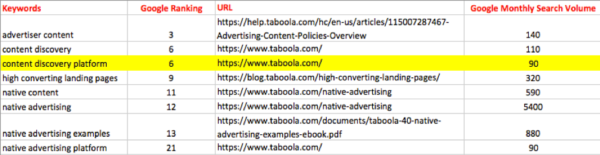
Although Taboola has first-page rankings on Google, several keywords aren’t hitting the mark and the best ones could do better.
Taboola (like many websites) would benefit from iterative SEO, meaning its team should make distinct revisions to the SEO page titles, content headers, and other text to see whether rankings improve without hurting their top positions. But they shouldn’t make too many changes at one time or they won’t know what worked and could disrupt rankings. They could monitor rankings after testing keyword-placement scenarios. (Most website pages are indexed within days or a couple weeks.)
For example, Taboola might avoid going after both “native content” and “native advertising” on the same page. “Native content” ranks No. 11 with 590 searches, but “native advertising” is No. 12 with 5,400 monthly searches. Both phrases rank well, but “native advertising” may not get much higher with “native content” having a strong presence.

Fortunately, Taboola used an H1 tag with “native advertising,” but it’s possible that phrase is on the page too many times (sorry, there isn’t a foolproof formula). With the high search volume, it might be worth tinkering with the text and the number of keyword references over a couple months.
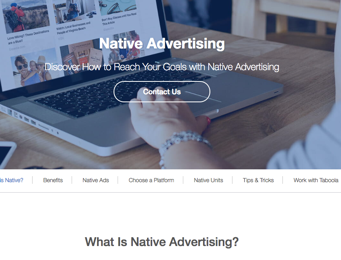
As for “native content,” Taboola may want to use that on another page or create a new page. Adding content is always a good approach to support a target keyword phrase.
Jellyvision should seriously consider that option. The business only has a few good rankings for low-volume keyword phrases. I’m actually a fan of keywords that aren’t searched often. They can yield good prospects for sales to help the bottom line. But more pages are needed.
The website has a strong collection of content. Jellyvision understands how businesses can convey critical information to employees. But that content often doesn’t relate to relevant keyword phrases. Sometimes its content keywords aren’t searched at all.

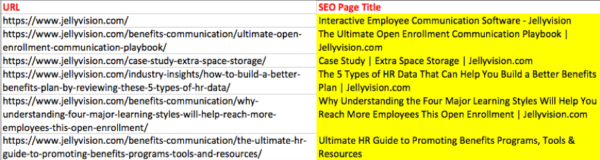
One of its content headers and SEO page titles is: Why Understanding the Four Major Learning Styles Will Help You Reach More Employees This Open Enrollment. The highest ranking for that page is 23rd for the phrase “benefits of learning styles” (30 monthly searches), which appears on the third page of Google. Maybe it’s good content – just not an effective string of words for SEO.
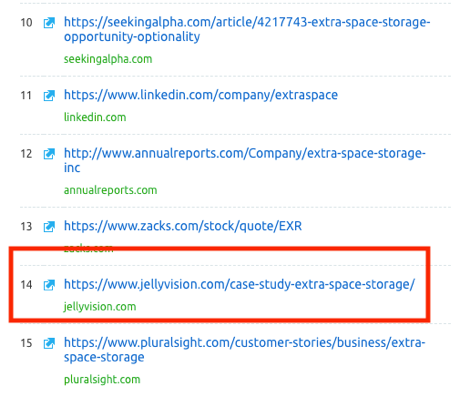
One of their best rankings is “extra space storage” – No. 14 with 135,000 monthly searches on Google. But it’s for a case study featuring a client. I doubt that website traffic helps much with conversions because people searching for “extra storage space” won’t find anything meaningful to them on this page.
Catalant struggles with SEO – at least with its apparent target keyword phrases. For starters, it is centered on a narrow topic – focusing on agility to connect with the right talent. The company has accolades from Forbes, Entrepreneur, and Financial Times. However, Catalant’s site can’t seem to rank well for words it cares about. If you can’t rank in your niche, you have a problem.
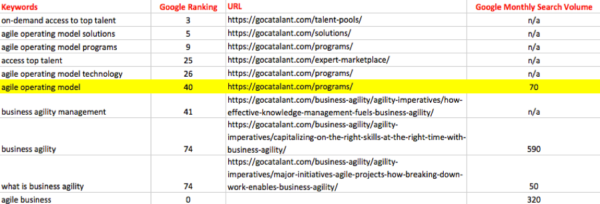
Sometimes it’s useful to branch out and look for related keyword phrases that are relevant but not as competitive.
The existing content may speak to core audiences, but it isn’t producing many strong organic results. For example, the content header Capitalizing on the Right Skills at the Right Time With Business Agility may seem OK, but it doesn’t include a keyword phrase within striking distance. The lengthy URL doesn’t help matters. Extraneous words prevent any focus and the URL is bogged down by “business” and “agility” duplication:
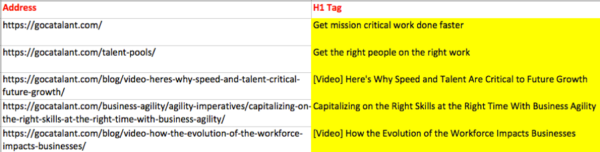
Catalant still has some hope. It could revise SEO page titles (even doing that can make a difference) and add new pages with keyword-focused content headers, short URLs, and effective SEO page titles.


No comments:
Post a Comment